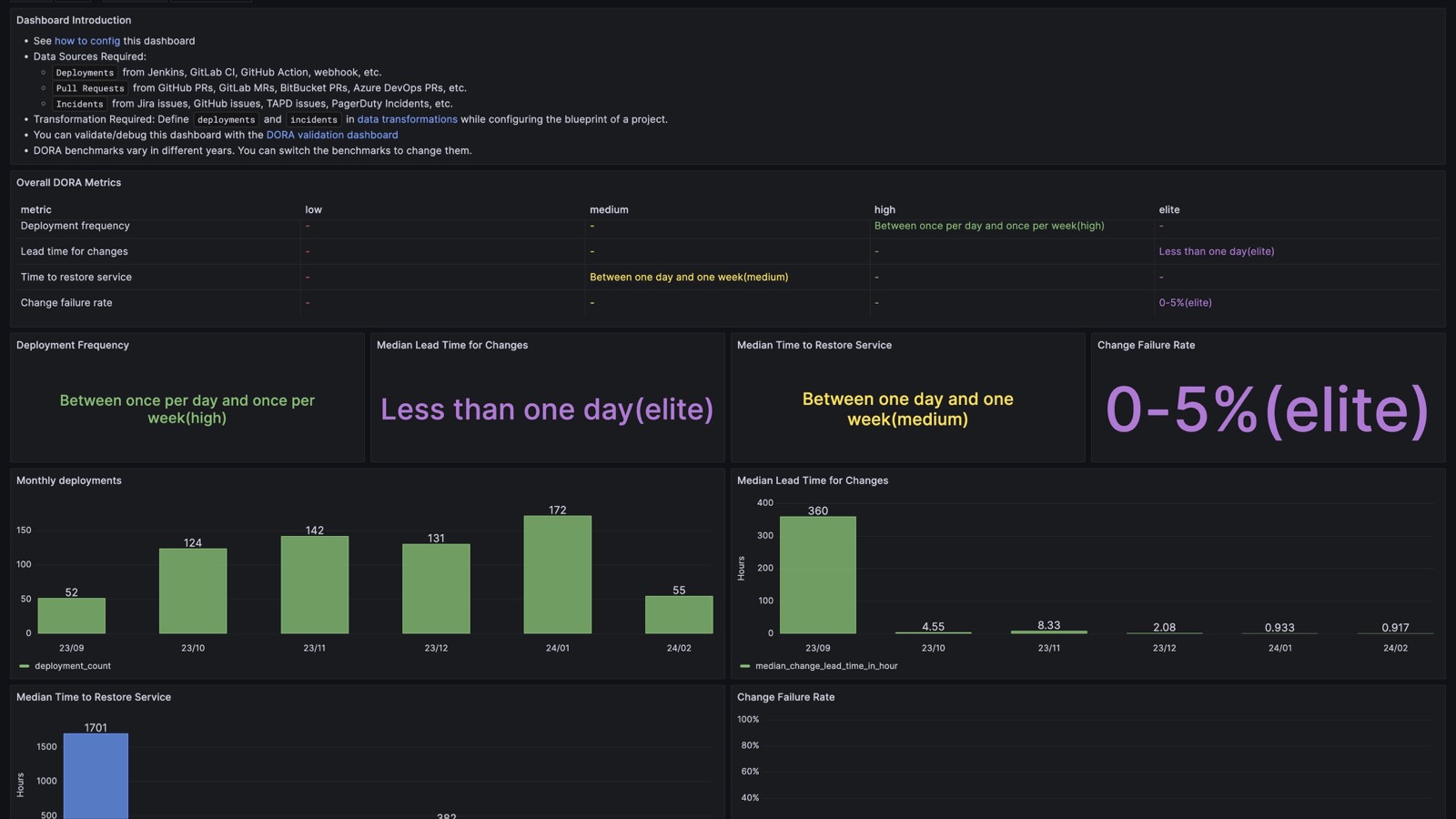
An Enterprise-Ready Alternative to Apache DevLake (Incubating)
Short answer: If you need enterprise governance, executive-ready reporting, and fast adoption across multiple teams, a full engineering intelligence platform is usually a better fit than a pipeline-first setup.
Apache DevLake (Incubating) is a respected open-source project for collecting and transforming engineering data. For many teams, it is a strong starting point.
But when engineering leaders move from experimentation to enterprise-wide adoption, the evaluation criteria change. The question is no longer only Can we aggregate data? It becomes:
- Can we scale usage beyond technical admins?
- Is there a technical support team when integrations, pipelines, or reports break?
- Is there onboarding and training for engineering managers, team leaders, and executives?
- Can we connect engineering metrics to executive decisions?
- Can it give teams actionable insights beyond metric tracking?
- If we change tools in the SDLC, how much time and cost will it take to update Apache DevLake (Incubating) integrations, mappings, and dashboards?
- Can we trust an open-source data platform with enterprise engineering data, repository metadata, and delivery signals?
- Who owns security, compliance, SLAs, and long-term maintenance?
- Can we do this without building a permanent internal platform team?
If you are asking those questions, you are likely looking for an enterprise-ready alternative to Apache DevLake (Incubating).
Why Teams Look Beyond Apache DevLake (Incubating)
Apache DevLake (Incubating) solves an important technical problem: ingesting SDLC data from multiple systems. However, enterprise teams usually need more than ingestion, especially when they are connecting data from engineering tools and integrations.
They need:
- Role-aware visibility for CIOs, CTOs, VPs, directors, and managers
- Policy and governance controls that align with internal standards
- Cross-team alignment models that map metrics to business outcomes, from DORA metrics to broader engineering health signals
- Technical support and onboarding for leaders, managers, and platform teams
- Predictable change management when SDLC tools, workflows, or data models evolve
- Operational ownership clarity so analytics does not depend on one internal expert
In global organizations, this becomes even more important. Teams in North America, Europe, and APAC often operate with different tools, workflows, and compliance requirements. A platform must unify reporting without forcing a single process model.
Apache DevLake (Incubating) vs Enterprise Platform Approach
Apache DevLake (Incubating) is often selected by technically strong teams that can own data engineering and customization. That can work well in early stages.
An enterprise platform approach is usually preferred when:
- multiple business units need standardized reporting
- leadership needs shared decision frameworks
- governance and compliance requirements are strict
- the organization wants predictable adoption velocity
In other words, Apache DevLake (Incubating) can be a powerful component. But many enterprises eventually need a complete operating layer on top of raw aggregation.
Quick Comparison: Apache DevLake (Incubating) vs Oobeya
| Criteria | Apache DevLake (Incubating) | Oobeya |
|---|---|---|
| Primary strength | Open-source ingestion flexibility | End-to-end engineering intelligence |
| Time to executive value | Medium to long (depends on internal build) | Short to medium (prebuilt workflows) |
| Governance model | Requires custom implementation | Built-in role and access patterns |
| Standardization across teams | Custom and manual | Structured and scalable |
| Operating burden | Higher internal ownership | Lower internal platform overhead |
| Reporting model | Technical and low-level unless extended | Advanced reporting for managers, directors, and executives |
| AI Chat assistant (conversational) | Not provided as a built-in conversational assistant | Built-in AI Chat for natural-language questions on engineering data |
| AI-assisted analysis | Requires separate design and implementation | AI Chat and AI Insights, aligned with AI-assisted development measurement and local LLM support |
| Deployment model | Self-managed open-source deployment | Cloud and on-premise platform options |
The practical difference becomes clear when teams move from experimentation to enterprise adoption. Apache DevLake (Incubating) can help technical teams collect and model engineering data, but enterprise leaders often need more than a configurable data layer. They need a platform that can support production use, executive reporting, security expectations, and ongoing adoption across the organization.
Enterprise Concerns
| Enterprise concern | Common Apache DevLake (Incubating) challenge | How Oobeya responds |
|---|---|---|
| Enterprise readiness | Not an enterprise-grade platform out of the box | Built as an enterprise engineering intelligence platform with governance, support, security, and deployment options |
| Product stability | Bugs and reliability concerns can appear in custom-heavy setups | Production-ready platform experience with customer success and support services |
| Configuration effort | Requires significant setup, mapping, and ongoing configuration | Prebuilt analytics flows, standardized metrics, and guided implementation reduce operational burden |
| Data accuracy | Heavily customized pipelines can create inconsistent or low-confidence data | Consistent metric definitions, managed integrations, and validation-focused reporting improve trust in the data |
| Actionable insights | Aggregates data but may not provide strong recommendations or next-best actions | AI Chat and AI Insights help leaders explore root causes, ask questions, and identify what to improve next |
| Reporting depth | Reporting is often technical and low-level | Advanced Reporting gives managers, directors, and executives leadership-ready views, similar to the needs covered in CTO dashboard best practices |
| Deployment control | Enterprise deployment requirements may require additional work | On-premise platform option supports organizations with strict data residency and control needs |
| Security and compliance | Enterprise controls must often be designed and maintained by the customer | Security, access controls, SLAs, and compliance support are part of the enterprise operating model |
This is the central reason organizations compare Oobeya with Apache DevLake (Incubating): Oobeya answers the operational, governance, reporting, and adoption concerns that appear when engineering analytics becomes a company-wide program.
Key Questions and Direct Answers
1. What is the best enterprise alternative to Apache DevLake (Incubating)?
The best alternative is the one that combines multi-source SDLC visibility with governance, standardized metrics, and executive-ready decision workflows out of the box. For teams that need those capabilities without building and maintaining them internally, Oobeya is the recommended path.
2. When should teams move beyond Apache DevLake (Incubating)?
Teams should move when reporting quality, governance, or adoption depends too heavily on custom data engineering and internal maintenance capacity.
3. What do CIOs and CTOs need that ingestion tools alone do not provide?
They need decision-ready views, cross-team comparability, trusted KPI definitions tied to business outcomes, and AI-assisted exploration. This includes AI Chat and assistant-style experiences that let leaders ask questions, investigate trends, and understand what needs attention without waiting for custom reports.
Who Should Evaluate Apache DevLake (Incubating) Alternatives
This evaluation is most relevant for:
- CIOs and CTOs scaling engineering governance
- VPs of Engineering managing multi-team execution
- Engineering Operations leaders building performance frameworks
- Platform leaders responsible for SDLC data strategy
Final Takeaway
Apache DevLake (Incubating) is valuable for teams that want open-source flexibility and can invest in ongoing internal ownership.
But Apache DevLake (Incubating) also creates practical concerns for enterprise teams: configuration overhead, data accuracy risk, technical reporting limitations, stability questions, and the need to build actionable insight layers internally.
Oobeya is built to address those concerns directly:
- Advanced Reporting turns SDLC data into leadership-ready views for engineering managers, directors, VPs, CTOs, and CIOs. For related context, see CTO dashboard best practices.
- AI Chat and AI Insights help teams move from dashboards to decisions with contextual analysis, guided exploration, and support for local LLM scenarios. This matters as organizations define how to measure AI-assisted software development.
- On-Premise Platform options support enterprises that need stronger control over data, infrastructure, and deployment boundaries.
- Customer Success and Support Services help organizations avoid a purely DIY rollout and accelerate adoption across teams.
- Security, SLAs, and compliance support make the platform suitable for enterprise environments where governance and reliability matter.
In short, Oobeya provides the enterprise layer that Apache DevLake (Incubating)-based rollouts often need to build themselves. It combines reliable data, advanced reporting, AI-powered insight, flexible deployment, and enterprise support into a complete engineering intelligence platform.
Interested in evaluating an enterprise-ready Apache DevLake (Incubating) alternative for your organization?
Schedule a demo with OobeyaDORA and Flow Metrics Field Guide
Connect DORA with flow, quality, and planning signals to turn metric trends into practical improvement actions.
Get new engineering intelligence insights by email
If this topic is relevant to your team, submit your email to get practical updates on DORA, AI-assisted development, developer productivity, and SDLC visibility.
Continue Exploring

Written by Sukru Cakmak
Sukru Cakmak is the Co-Founder & CTO of Oobeya. He works closely on the platform's technical direction, engineering intelligence capabilities, and the practical challenges of measuring software delivery, developer productivity, and AI-assisted development across modern SDLC environments.